


Afterburner - Naval Aviators And The Vietnam War
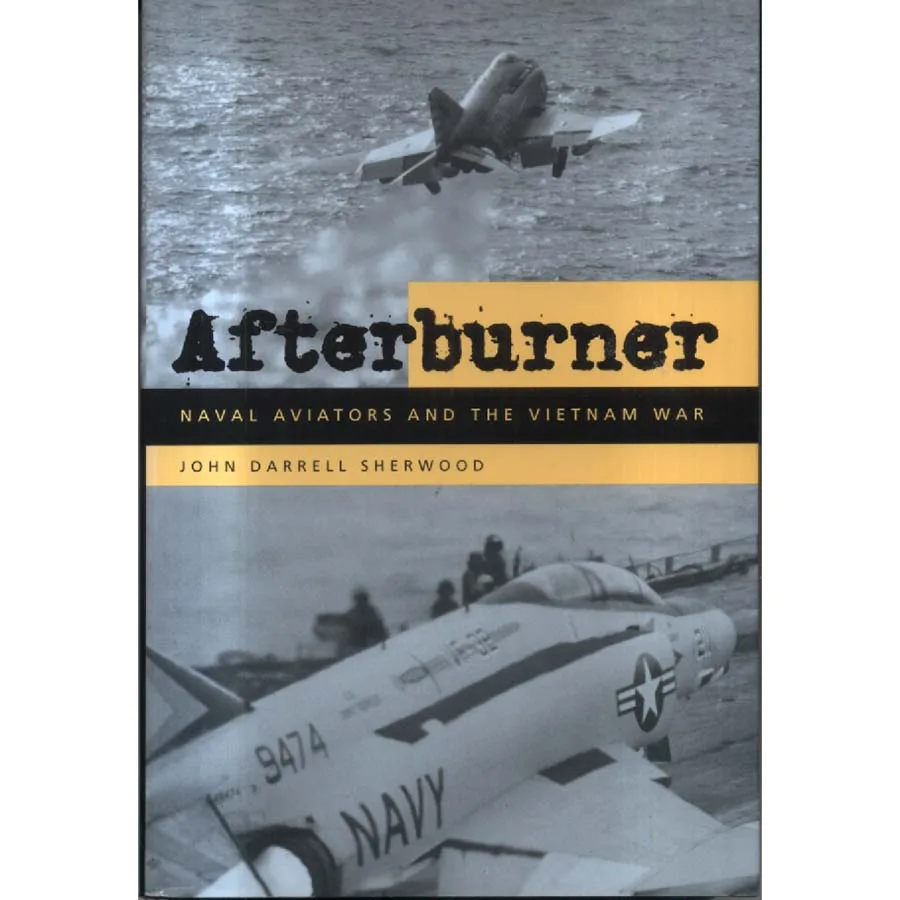
Publisher: New York University Press
Format: Hardback
ISBN: 9780814798423
There are few human activities more calculated to make ordinary employment seem embarrassingly tame than being fired from an aircraft carrier in a jet full of fuel, explosives and extremely urgent intentions. Afterburner is John Darrell Sherwood’s absorbing history of the United States Navy’s aviators during the latter stages of the Vietnam War, when sophisticated aircraft, formidable training and truly staggering quantities of ordnance were brought together in the continuing hope that geopolitics might eventually agree to behave itself.
The book concentrates particularly on 1972, the most intense year of the Navy’s air war. North Vietnam’s Easter Offensive prompted a massive American response, including the Linebacker bombing campaigns and Operation Pocket Money, the mining of Haiphong Harbor. Carrier decks became floating factories of organised violence, launching aircraft around the clock while pitching about on the sea—a working environment in which leaving a spanner somewhere inconvenient could become an international incident.
Sherwood combines operational history with the experiences of twenty-one naval and Marine aviators, including pilots and naval flight officers. Drawing upon interviews, recollections and personal records, he gets behind the familiar pictures of gleaming jets and heroic silhouettes to examine the people strapped inside them. They were highly trained professionals, certainly, but also frightened, exhausted and occasionally bewildered human beings attempting to complete complex missions while strangers on the ground made energetic efforts to kill them.
There are encounters with MiGs, attacks on heavily defended targets and missions against surface-to-air missile sites. The notorious “Iron Hand” crews deliberately went hunting for enemy radar installations whose principal purpose was to shoot them down—rather like entering a dark cellar to locate an angry tiger by waiting for it to bite first. Technology mattered enormously, but so did instinct, judgement, teamwork and the remarkably useful ability to remain calm while warning lights began expressing strong opinions.
The book also gives proper attention to naval flight officers, the navigators, radar intercept officers and other back-seaters whose contribution was essential, despite the occasional condescension of pilots who naturally preferred to imagine that they alone were holding the entire aircraft—and perhaps Western civilisation—together. Sherwood shows how these specialists operated increasingly complicated electronic systems, guided missions and helped crews survive a battlefield becoming more technologically lethal by the month.
Away from combat itself, he explores the peculiar society of naval aviation: its rituals, rivalries, confidence, dark humour and professional pride. Carrier aviation demanded a curious mixture of absolute discipline and carefully controlled recklessness. Everyone had to follow procedures precisely, except when the procedures ceased to fit events, at which point someone travelling at several hundred knots had to invent a better answer immediately.
Sherwood does not restrict himself to the glamorous machinery. He also examines operations over Laos, the changing technology of aerial warfare and the experiences of men shot down and taken prisoner. The sections dealing with captivity are necessarily sobering. Here the swagger of the ready room gives way to endurance, isolation and the grim daily work of remaining oneself under conditions designed to make that increasingly difficult.
This is not merely a catalogue of aircraft, missions and military abbreviations, although enthusiasts will find plenty of all three. Nor is it an uncomplicated celebration of airborne heroism. Sherwood sets individual courage against the unsettling arithmetic of the wider war: enormous expenditure, nearly eight million tons of bombs dropped across Southeast Asia and no tidy, definitive victory waiting at the end. It is difficult to imagine a more expensive demonstration that history does not always respond positively to additional horsepower.
As an official naval historian, Sherwood understands both the machinery of operations and the institutions that organised them. Yet his real interest lies in the aircrews themselves: what they believed, how they coped and how the war looked from a cockpit rather than a conference table. The result is both military and social history, restoring human scale to a conflict so often narrated through tonnage, targets and political declarations issued by men comfortably beyond missile range.
Published by New York University Press in 2004, this is an intelligent and highly readable study of skill, bravery, technology and institutional culture during one of the most controversial wars of the twentieth century. It should appeal to readers of aviation history, naval history, Vietnam studies and anyone wondering what happens when extremely competent individuals are asked to solve an essentially political catastrophe from 20,000 feet.
This copy is in As New condition: clean, crisp and apparently spared the traditional hazards of second-hand-book service. No dog-eared flight plan, no coffee-ringed briefing notes and no suspicious smell of aviation fuel. It looks scarcely read and is ready for immediate deployment to a shelf, desk or suitably reinforced bedside table.
Sold by Crappy Old Books, where the stock may be grounded but the descriptions continue flying dangerously low. No catapult launch is required; we shall dispatch it by the rather less dramatic machinery of the postal system.
Keep browsing: See more War books Other books by John Darrell Sherwood
